
The Internet of Things spent its early years proving that devices could be connected to networks. That work is largely done. Today, the harder questions involve scale, reliability, and responsibility. IoT systems are no longer isolated experiments or pilot programs; they are embedded in facilities, vehicles, infrastructure, and industrial processes where failure carries operational and financial consequences.
What distinguishes the current phase of IoT is not the number of connected devices, but what we expect them to do: operate continuously, tolerate imperfect networks, receive updates without interruption, and remain secure over long service lives. They must also integrate with existing operational technology, enterprise software, and regulatory frameworks, often under constraints that were not considered during early design phases.
As a result, IoT has shifted from connectivity to operations. The engineering effort now centers on managing fleets of heterogeneous devices, balancing local processing with cloud services, and maintaining trust across distributed systems that interact directly with the physical world. This evolution marks the point at which IoT stops being a novelty and begins behaving like infrastructure.
IoT is no longer about proving that devices can be connected. That question was settled years ago. What matters now is whether large numbers of networked systems can be operated safely, maintained over long lifetimes, and trusted to interact with physical processes without constant intervention. Sensors and controllers now influence power grids, factories, transportation systems, medical equipment, and public infrastructure. When these systems fail, the impact is measured in downtime, safety risk, and cost, and not lost packets or dashboard alerts.
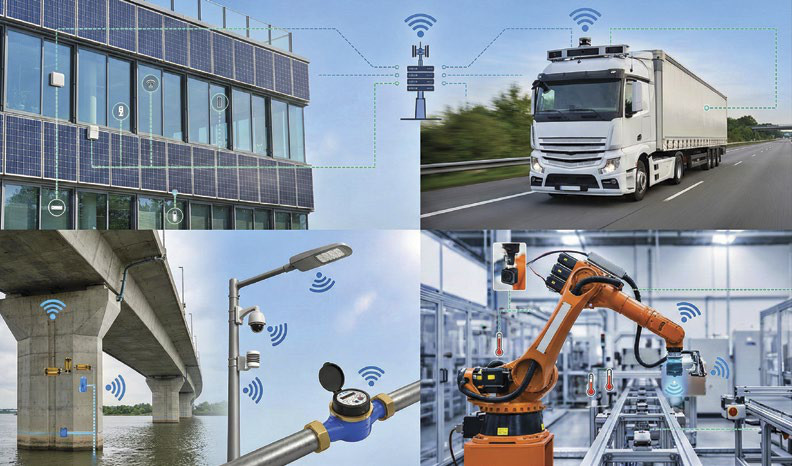
Today’s IoT environment reflects that shift. It is best understood as a systems architecture that spans hardware, networking, software, and operations rather than as a standalone technology. Modern deployments are designed around how data is generated, processed, and acted upon across distributed locations. Connectivity is assumed. The harder problem is coordinating sensing, computation, communication, and control in ways that remain predictable under real-world constraints.
At the device level, IoT hardware covers a wide range of capabilities. Some nodes are still built around small microcontrollers that perform a single function and transmit limited data. Others resemble embedded computers, running full operating systems and hosting multiple applications. Many devices now integrate multi-core processors, radios that support multiple standards, and cryptographic hardware. Power management continues to shape nearly every design decision. Duty cycles, sleep states, and radio behavior are tuned carefully, particularly in deployments where battery replacement is costly or impractical.
Networking reflects similar diversity. Short-range wireless technologies based on IEEE 802.15.4, Bluetooth Low Energy, and sub-GHz radios remain common for local device networks. These are often paired with Ethernet or fiber in fixed installations, and with cellular connectivity for wide-area coverage. LTE-M, NB-IoT, and increasingly 5G are used where managed connectivity and predictable service levels are required. In practice, most systems rely on gateways that sit between these networks and IP backbones, handling routing, security, and traffic control while insulating constrained devices from upstream complexity.
Communication protocols have been settled into patterns shaped by device limitations and network behavior. Lightweight protocols such as MQTT and CoAP are widely used for telemetry and command exchange, while HTTPS is often reserved for configuration and management. Data formats are chosen to balance size, processing overhead, and interoperability.
Cloud infrastructure remains central to many IoT deployments, but its role has become more defined. Telemetry is typically aggregated into time-series databases and processed through stream-based pipelines that support filtering, correlation, and event detection. These platforms also handle device provisioning, configuration management, and integration with enterprise systems.
That shift has made edge computing a standard part of IoT system design. Functions such as data reduction, local analytics, and control logic are increasingly executed at or near the source. Edge nodes often run containerized workloads or lightweight virtual machines, allowing software updates without replacing hardware.
Operational management has emerged as one of the most demanding aspects of IoT. Large fleets include devices with different hardware versions, firmware levels, and connectivity conditions. Operators rely on monitoring systems to track health and performance, while logs and diagnostics support remote troubleshooting.
In short, the current state of IoT reflects a transition from experimentation to infrastructure. The success of future deployments will depend less on new connectivity options and more on the ability to operate distributed systems with defined performance, security, and maintenance characteristics over long periods.