
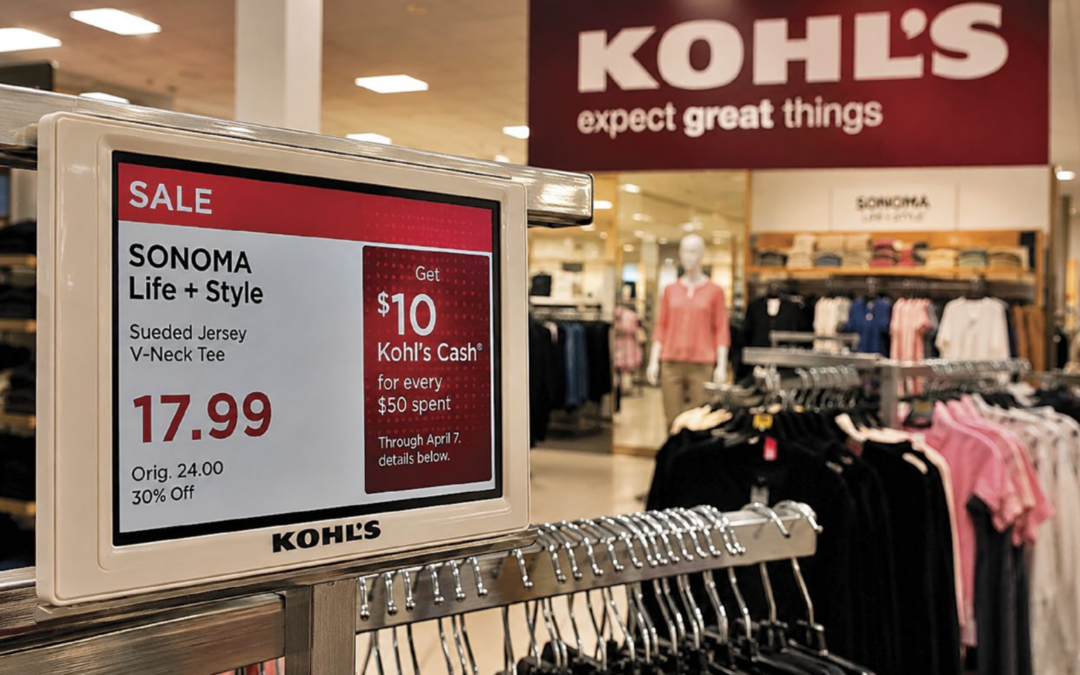
European grocers pioneered electronic labels, but Kohl’s brought wireless signage to U.S. department stores at scale.
More than 15 years ago, shoppers walking through Kohl’s stores encountered something remarkably advanced for its time. Mounted above clothing racks and merchandise fixtures were electronic signs whose prices and promotional messages could be changed remotely over a wireless network.
While most U.S. retailers still depended almost entirely on employees replacing paper signs by hand, Kohl’s was quietly operating what would now be recognized as a large-scale connected-retail system.
The project deserves renewed attention because wireless electronic labels are now spreading rapidly across supermarkets, mass merchants and other retail environments. Yet Kohl’s had already identified a particularly practical application for the technology years earlier.
The company’s system was designed to distribute pricing and promotional information to electronic signs positioned throughout its stores. That’s fundamentally different from what’s being described today as “surveillance pricing”, when companies use an individual’s personal data, digital tracking, and AI algorithms to set personalized, individualized prices for goods and services. Instead, this article describes the wireless communications network and its operational benefits and in no way suggests that Kohl’s used customer information to establish individualized prices. What it shows is that Kohl’s was far ahead of its competitors beginning more than 15 years ago.
Kohl’s was not the first retailer to deploy electronic labels. European supermarkets and hypermarket chains had adopted earlier generations of the technology before 2010. What made Kohl’s unusual was its early, large-scale application within a major U.S. department-store chain, where larger wireless signs replaced the repeated manual resetting of promotional signage across hundreds of stores.
An Early Rollout
Kohl’s publicly disclosed its electronic-sign initiative in 2010. In a filing with the Securities and Exchange Commission, the retailer said it planned to test electronic signs in 100 stores that fall. If the pilot proved successful, the company expected to expand the system substantially. Kohl’s subsequently reported that electronic signs had been installed in about 100 stores during 2010. The company identified the project as one of several productivity initiatives intended to improve the efficiency of store operations and control hourly payroll expenses.
By the end of fiscal 2011, Kohl’s reported that 475 stores had been equipped with electronic signs. This was not a limited demonstration in a few showcase locations. It was a meaningful commercial deployment across hundreds of large-format stores at a time when wireless retail displays remained relatively uncommon in the United States.
Kohl’s had recognized that its promotional model created an unusually strong business case for electronically controlled signage. The company regularly changed sales offers, discounts, and promotional messages across a large number of departments. Automating those changes reduced the need for employees to print, distribute, install, and later remove paper signs.
It also improved consistency between the promotional information displayed on the sales floor and the pricing programmed into the company’s retail systems.
More than a Digital Sign
To a shopper, each unit appeared to be little more than a screen attached to a merchandise fixture. From an engineering standpoint, however, the displays were endpoints in a distributed wireless network.
Each sign required several basic elements:
- A low-power radio receiver or transceiver
- A display controller
- A unique device address
- A battery or other local power source
- Memory for storing pricing and promotional information
- A method of associating the sign with the correct merchandise
The data payload was extremely small. A product description, price, discount, and several lines of promotional text require very little bandwidth compared with conventional Wi-Fi or cellular applications.
Bandwidth, however, was not the principal challenge. A practical retail system had to communicate reliably with a large number of devices distributed throughout a store filled with metal racks, shelving, mirrors, merchandise and moving shoppers. The propagation environment changed continuously as products were rearranged and people moved through the aisles.
Displays also had to operate for extended periods without frequent battery replacement. That required radios, processors and screens designed around an extremely low duty cycle. Most signs spent the majority of their time displaying the same information, so their electronics could remain in low-power states between updates.
The network also needed a way to address individual signs or groups of signs. A storewide sale might require many displays to change at once, while a markdown affecting one product category might involve only a small subset.
Depending on the system architecture, the network could also verify whether a sign had received an update, identify a nonresponsive endpoint, or report a low-battery condition. The engineering objective was not high throughput. It was dependable communications with a dense population of devices consuming very little energy.
Reconstructing the Original System
Publicly available corporate filings document Kohl’s rollout and its operational objectives, but they provide relatively little technical detail about the original radio system. Contemporary retail-industry reports identified Altierre Corp. as a supplier associated with electronic signs used by Kohl’s. Altierre developed proprietary, ultra-low-power wireless networks for electronic shelf labels and related retail displays.
Public regulatory records from the period also show that Altierre was certifying electronic-label equipment operating in the 2.4-GHz industrial, scientific and medical band. That spectrum was already shared with Wi-Fi, Bluetooth and numerous proprietary wireless systems.
However, publicly accessible documentation does not conclusively establish that every Kohl’s deployment used the same Altierre hardware model, frequency plan or network configuration. The precise architecture may also have changed as the system expanded or was upgraded.
The most reasonable technical reconstruction is that each store used one or more centrally connected RF access points or controllers to communicate with electronic signs throughout the sales floor. Pricing and promotional information would have originated in Kohl’s merchandising systems, passed through the store’s local technology infrastructure, and then been transmitted to the appropriate displays.
The network may have used proprietary communications techniques optimized for extremely low power and large endpoint populations. Bidirectional communications would have allowed signs to acknowledge updates or report status information, although the exact protocol and implementation used in the original Kohl’s system have not been publicly documented in sufficient detail to describe them conclusively.
The broad architecture is clear even where the implementation details are not: centrally managed retail data was distributed over a local wireless network to battery-powered displays positioned throughout the store.
The importance of the Database
Electronic signage is sometimes presented primarily as an RF problem. In reality, the radio link was only one part of a much larger operational system. Each sign had to be associated with the correct product, rack, or merchandise group. The price displayed on the sales floor had to correspond with the information in the retailer’s merchandising and point-of-sale systems.
If merchandise moved, the associated sign had to move with it or be reassigned. If a department was reorganized, the database mapping between signs and products had to be updated. If a display stopped responding, store employees needed a way to identify and correct the problem.
A wireless network could deliver a message perfectly and still show incorrect information if a sign had been linked to the wrong product.
The system therefore required more than radios and displays. It also depended on:
- Merchandising-database integration
- Store-level network management
- Device-association procedures
- Handheld tools or administrative software
- Exception reporting
- Maintenance and battery-replacement procedures
- Staff training
For a retailer operating hundreds of locations, centralized control offered enormous operational reach. It also required disciplined data management, because incorrect information could be distributed just as efficiently as accurate information.
This backend integration was likely one of the reasons many retailers were slow to adopt electronic signage. The visible display was relatively simple. The larger challenge was incorporating it into decades-old pricing, inventory, point-of-sale and store-management systems.
Why Kohl’s Got In Early
Kohl’s had an unusually favorable operating environment for electronic signage. The company relied heavily on frequent sales, promotional events, percentage discounts and changing offers. Those promotions traditionally required employees to replace large numbers of printed signs throughout each store. The labor involved was repetitive, time-sensitive, and easily understood. Electronic signs could reduce that workload while also helping stores implement promotions more consistently.
Kohl’s also avoided the most expensive version of the electronic-label problem. A supermarket may contain tens of thousands of shelf positions, each potentially requiring its own small electronic label. A Kohl’s display could represent an entire rack, fixture, clothing style, or merchandise group.
The retailer could therefore obtain much of the benefit of automated pricing without attaching a wireless display to every individual product. That distinction substantially improved the economics.
A lower endpoint count meant:
- Fewer displays to purchase
- Fewer devices to install and associate
- Lower network density
- Less ongoing maintenance
- Fewer batteries to monitor and replace
- A simpler physical deployment
The larger signs used in department stores also had more room for readable displays, batteries and radio electronics than a compact shelf-edge label. Kohl’s had effectively selected the portion of the problem where the operational benefit was high, and the number of wireless endpoints remained manageable. That was the strategic insight behind the rollout.
Why Most Retailers Waited
The fact that Kohl’s found an attractive application did not mean the same economics applied to every retailer. A store that changed prices infrequently could continue using paper labels at very low material cost. Even when labor was required to replace them, the savings might not justify the capital expense of electronic displays, RF infrastructure and backend software.
Electronic-label hardware was also more expensive 15 years ago. Displays, low-power radios, batteries and controllers did not yet benefit from the scale and integration now common in the Internet of Things market.
Most early systems also used proprietary communications protocols. A retailer adopting one of them risked becoming dependent on a single vendor for:
- Compatible replacement displays
- Access points
- Management software
- Firmware support
- Spare parts
- Future system expansion
That was a substantial commitment for an application traditionally handled with inexpensive paper.
The introduction of a standardized Bluetooth Electronic Shelf Label profile many years later illustrates how significant interoperability and vendor dependence had been as barriers to adoption.
Retailers also had to consider the physical realities of store operations. Displays are moved, knocked loose, damaged, placed on the wrong fixture, or left behind during department resets. Products are discontinued, packaging changes, and merchandise is routinely reorganized.
Electronic signs eliminated a large amount of paper-handling labor, but they did not eliminate the need to manage the relationship between the digital display and the physical merchandise. For many retailers, waiting for lower hardware costs, better battery life, more mature software and broader vendor competition was a rational decision.
Retail Technology Catches Up
Modern electronic shelf-label systems benefit from technical advances that were either unavailable or considerably more expensive when Kohl’s began its rollout. Contemporary systems use improved e-paper displays, highly integrated low-power radios, inexpensive microcontrollers and more capable network-management platforms. Battery life can extend for years, depending on display size, update frequency and operating conditions.
The labels can also perform more functions than simply showing prices.
Some include LEDs that flash to help employees locate merchandise while fulfilling online orders. Others support inventory management, replenishment, planogram verification, markdowns and product-location services. Cloud-based software can coordinate pricing and promotional information across thousands of stores. Handheld devices can associate a label with a product by scanning both identifiers. Network-management platforms can locate failed devices and confirm that updates were completed successfully.
These additional capabilities improve the economic case. A display that only replaces paper must justify its cost through reduced sign-changing labor. A display that also speeds order picking, supports inventory management and improves store accuracy can generate value across several operations.
As a result, the retail industry is now moving more broadly toward an architecture that Kohl’s recognized much earlier: centrally managed information delivered over a low-power wireless network to displays distributed throughout a physical store.
The terminology has evolved. The devices are generally called electronic shelf labels, while the network may be described as an IoT platform. The basic engineering concept, however, would have been entirely familiar to anyone who examined the Kohl’s system more than a decade ago.
The most striking aspect of Kohl’s electronic-sign deployment may be how little public attention it received. It operated in full view of millions of shoppers, yet few people recognized it as an unusually early large-scale wireless application. That lack of attention was not necessarily a weakness. In many respects, it demonstrated that the technology had been successfully absorbed into normal store operations.
Customers did not need to understand the RF network. Employees did not need to think of themselves as managing an IoT platform. The system simply updated promotional information, reduced paper handling, and removed repetitive work from the sales floor.
Kohl’s did not need broadband communications to every display. It needed to transmit small amounts of information reliably to battery-powered devices and keep those devices synchronized with its merchandising systems.
The technical requirements were modest in terms of bandwidth but demanding in terms of reliability, power consumption, endpoint management and operational integration. Kohl’s also showed that successful wireless adoption often depends less on deploying the most advanced radio technology than on selecting the right business problem.
The company found an application with frequent information changes, measurable labor costs and a manageable number of endpoints. That combination made electronic signage practical years before the economics worked as broadly across other retail categories.
Today, wireless shelf labels are frequently presented as a new chapter in retail automation. In reality, Kohl’s had already written an important part of that story. Its achievement was not merely installing electronic signs early. It was recognizing where the technology could deliver immediate operational value and putting a large wireless network to work while much of the retail industry continued changing paper signs by hand.